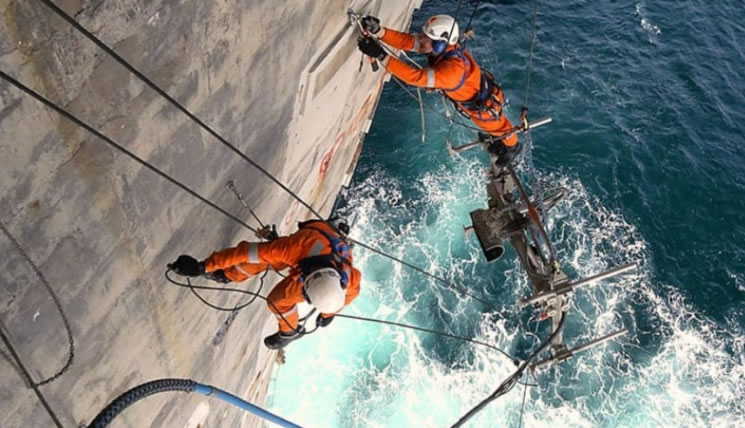
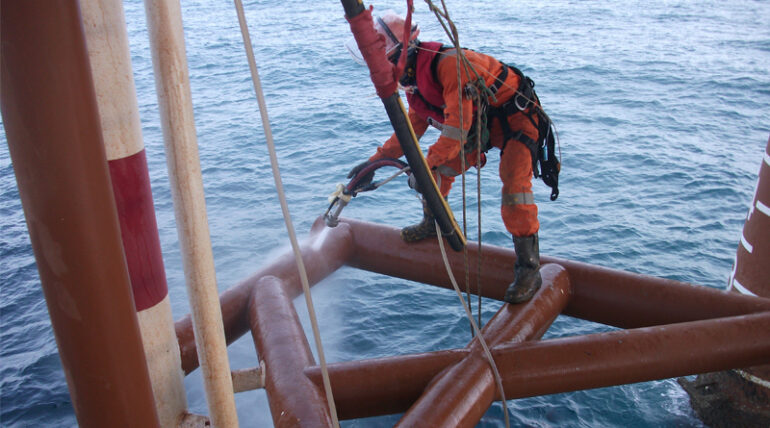
When you price a rope access campaign, the quote lists technicians by level. Level 1, Level 2, Level 3. Those numbers decide what the crew is allowed to do on your asset, how quickly the work moves, and what happens if a technician gets into trouble forty metres up a flare boom.
A lot of operators approve a crew mix without knowing what separates the levels. It is worth understanding, because the wrong mix costs money in ways that only show up once the team is already offshore and the vessel is on day rate.
What IRATA certification actually covers
IRATA International sets the training scheme that most of the offshore industry works to. A technician trains, logs hours, then sits a practical and theory assessment with an independent assessor. The certification runs for three years. After that they revalidate or they stop working on ropes.
The scheme is built around one idea: nobody works alone, and every team on site can rescue its own people without waiting for help to arrive. That principle drives the crew structure, and it is why you cannot simply hire three Level 1 technicians and send them offshore.
Level 1
A Level 1 technician can climb, descend, change from rope to rope, pass a deviation and get to a workface safely. They work under supervision at all times. They are not there to plan the rigging or to run a rescue.
Level 1 is where the productive hours come from. On a large blasting or painting scope, most of your crew will sit at this level, and that is the correct way to build a team. What they cannot do is make the call when the plan meets reality and the plan loses.
Level 2
A Level 2 technician has logged at least a year and a thousand hours on ropes since qualifying at Level 1. They rig more complex systems, build anchors, run hauling and lowering setups, and carry out rescues from a range of situations.
This is the level that keeps a job moving. When access to a node turns out to be tighter than the drawings suggested, a Level 2 can re-rig it rather than send everyone back to the deck while a supervisor is found.
Level 3
A Level 3 is the supervisor. Another thousand hours and another year beyond Level 2, plus a current first aid certificate. They take responsibility for the whole rope access operation on site: the method statement, the rigging, the rescue plan, the daily decisions about weather and fatigue.
IRATA requires a Level 3 supervisor present wherever rope access work is happening. Not on the beach, not on another platform, on site. If your contractor proposes a scope without one, that is not a cost saving. That is a scope that should not start.
Building the right crew mix
There is no single correct ratio, and anyone who quotes you one without asking about the work has not read the scope. What drives the mix is the nature of the access, not the size of the crew.
A straightforward painting scope on open steelwork, with good anchor points and clear escape routes, carries a high proportion of Level 1 technicians under one supervisor. The work is repetitive and the rigging barely changes from one day to the next.
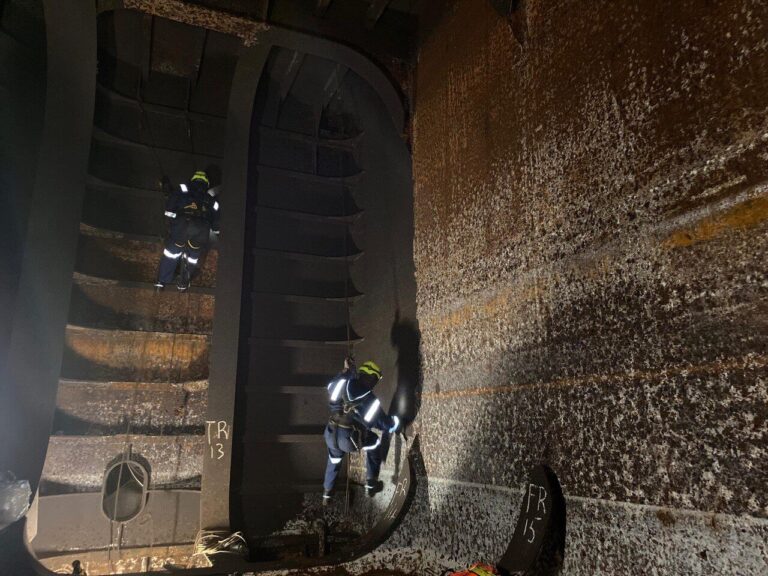
Confined space work is a different problem. Tank internals, caisson inspections and anything where a casualty cannot simply be lowered to the deck need more Level 2 capability in the team, because the rescue is the hard part and it has to be solvable by the people already inside.
Two things are worth asking any contractor before you sign. First, how many Level 3 supervisors are on the crew list, and are they dedicated to supervision or also counted as productive hours. Second, what is the rescue plan for the worst access point in the scope, and which specific technicians execute it.
Why the mix shows up in your budget
Rope access saves money against scaffolding mainly by removing the build and dismantle time, which we looked at in detail in our comparison of rope access and scaffolding for offshore maintenance. That saving depends on the crew being able to solve access problems in place.
An under-levelled crew loses that advantage. Every unexpected obstruction becomes a stop, a call to the beach, and a revised method statement. On a vessel-supported campaign, a day lost to a rigging question the crew could not answer costs more than the entire difference between a Level 1 and a Level 2 day rate for the whole scope.
The opposite error is rarer but real. Loading a simple scope with senior technicians raises the rate without raising output, because the constraint on a straightforward painting job is surface area and weather, not technical skill.
Checking certification before mobilisation
Every IRATA technician carries a logbook and a certificate with a number that can be verified. Ask for the numbers at the crew nomination stage rather than on the helideck. Check the expiry dates against the planned campaign window, because a certificate that lapses midway through a six week scope is a problem you want to find in the office.
It is also worth checking logged hours rather than just levels. A technician who qualified at Level 2 four years ago and has worked steadily is a different proposition from one who qualified last month at the minimum hours.
Getting the crew right for your scope
The crew list is not an administrative detail. It determines whether your campaign finishes inside the weather window or carries into the next one.
Integra Offshore supplies IRATA certified rope access technicians and technical manpower across inspection, welding, coating and maintenance scopes, and we build the level mix around the access rather than around a template. If you have a scope coming up and you want a second opinion on the crew structure before it goes out to tender, talk to us.