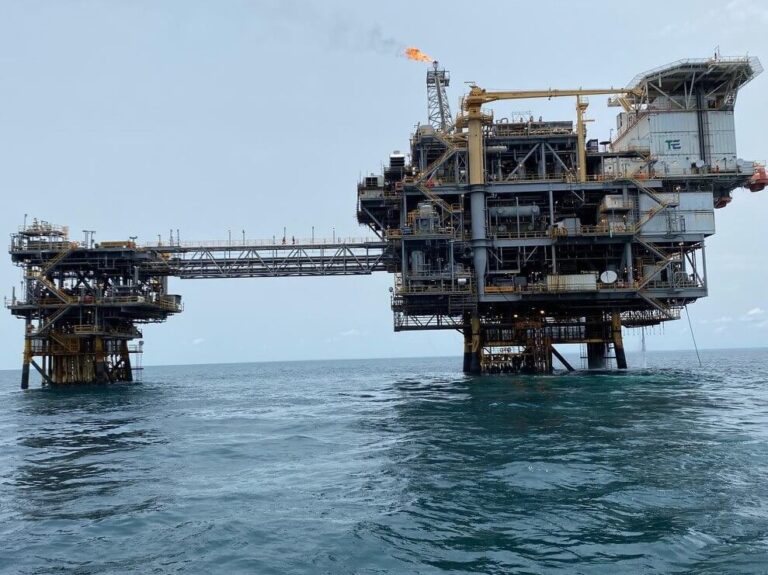
Corrosion under insulation is the most expensive damage mechanism on many offshore facilities, and the reason is simple. It happens out of sight, under cladding that looks intact, on lines that pass every visual inspection until the day one of them leaks. By the time evidence appears on the outside, the wall loss underneath has usually been developing for years.
How CUI forms
Insulation systems are not waterproof. Water enters through damaged cladding, failed sealant at joints, penetrations for supports and instrument connections, and simple condensation. Once water reaches the steel it cannot readily escape, because the insulation that keeps heat in also keeps moisture in. Offshore this is aggravated by chlorides in the marine atmosphere, which accelerate attack and, on austenitic stainless steel, introduce the risk of external chloride stress corrosion cracking.
Temperature governs the severity. The damaging condition is a surface that stays wet. Very hot lines drive water off as steam, and lines held well below freezing keep it as ice. The band in between is where liquid water persists against the steel, broadly from around 50 to 175 degrees Celsius on carbon steel, and that is where the most aggressive wall loss is found. Lines that cycle in and out of that band, or that sit idle for long periods, are worse again, because each cycle draws in fresh moist air.
Why routine inspection misses it
Most inspection routines are built around what can be seen and reached. Insulated lines defeat both. Cladding hides the substrate completely, and the visual condition of the cladding is a poor predictor of what is underneath. Neat, recently painted cladding can conceal severe pitting, while weathered cladding can cover perfectly sound steel.
The second problem is prioritisation. On any facility there is more insulated pipework than any campaign can strip and inspect. If the selection of what to open is arbitrary, the inspection effort is close to a lottery. Programmes that produce results are the ones that target inspection where the mechanism is credible and the consequence of failure is high.
Building a credible target list
A useful CUI programme starts on paper, not on the deck. The inputs are operating temperature, insulation type and age, cladding condition, geometry and service history.
Geometry matters more than people expect, because water collects in predictable places. Low points, dead legs, supports and hangers where the insulation is penetrated or crushed, valve and flange boxes, terminations at vessel nozzles, and any point where cladding has been cut and refitted after previous work. Bends and tees where cladding is difficult to seal are more suspect than long straight runs.
Service history is the other strong signal. Lines that have been opened before, lines that have had leaks or repairs, and lines that were re-insulated by a contractor working to a different standard all carry elevated risk.
What actually finds it
There is no single technique that solves CUI, and vendors who claim otherwise are selling something.
Stripping and direct inspection
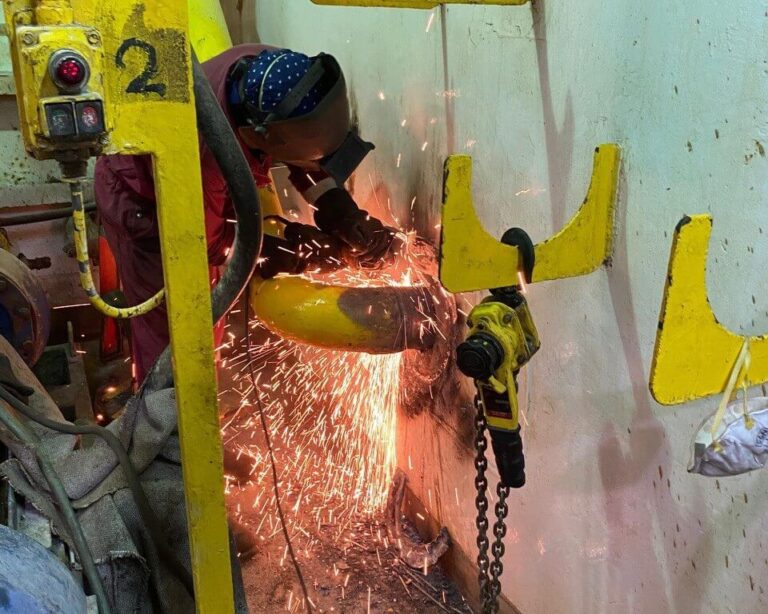
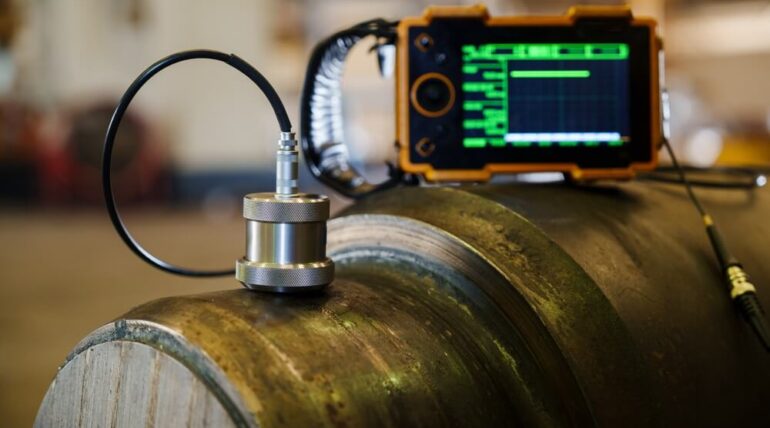
Removing insulation and inspecting the surface directly remains the most reliable method, because it produces certainty rather than probability. It is also the most expensive and the most disruptive, so it has to be aimed carefully. Where CUI is confirmed, direct inspection with ultrasonic thickness measurement gives the wall loss figures that engineering needs.
Screening without removal
Several techniques give an indication without stripping. Pulsed eddy current can assess average wall thickness through insulation and cladding, which makes it useful for screening long runs and reducing the population that needs opening. Real time radiography can image a section of pipe with the insulation in place, and is particularly useful at supports and other geometry where water sits. Guided wave ultrasonics can screen substantial lengths from one access point and flag areas for follow up.
Each of these narrows the search. None of them replaces direct measurement where a repair decision is required, and the results still need interpretation by someone who understands the limitations of the method. Our guide to choosing inspection methods covers how to match technique to the decision you need to make.
Access is the constraint
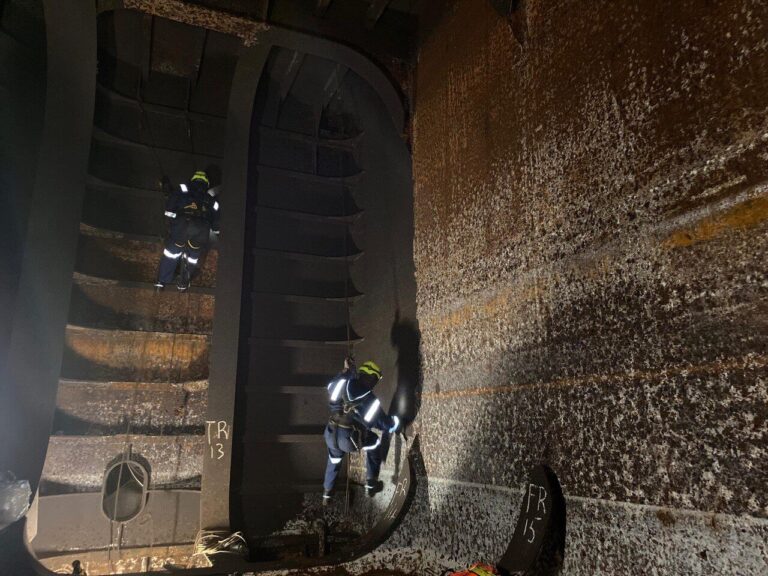
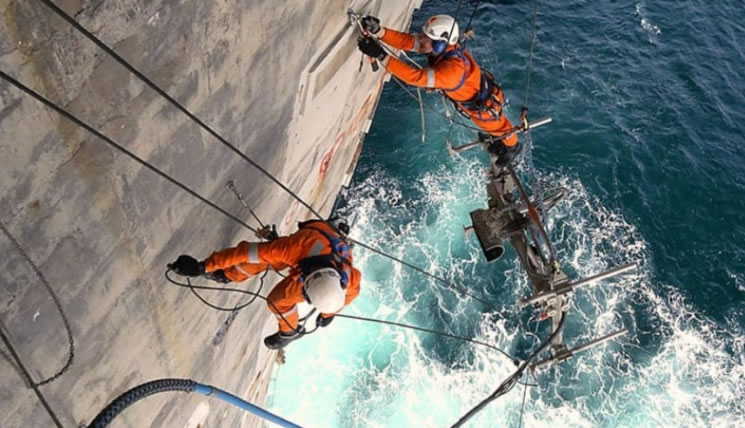
The practical brake on CUI work offshore is rarely the inspection technique. It is getting people to the pipe. Insulated lines run at height, through congested pipe racks, over water and inside modules where scaffolding is slow to build and occupies space the facility needs.
This is where rope access changes the economics. Technicians who are both IRATA qualified and inspection qualified can reach a target, remove a cladding section, take readings, and reinstate the insulation and cladding in one visit, without a scaffold cycle either side. That makes it viable to inspect more targets in a given window, which is exactly what a probability driven programme needs.
Closing the loop
Finding CUI is only useful if what follows is properly executed. Reinstating insulation and cladding badly guarantees that the same location will be back on the list in a few years. Vapour barriers need to be continuous, cladding overlaps need to shed water rather than channel it inward, and penetrations need sealing properly rather than with a smear of mastic.
Where wall loss requires repair, the coating specification underneath the insulation is part of the solution. Coatings designed for CUI service, applied to a properly prepared surface, buy years of protection. The failure modes there are the same ones we describe in our post on why coating campaigns fail: inadequate preparation and unrealistic weather windows.
A programme rather than a campaign
CUI does not respond well to one off effort. It responds to a repeating cycle in which the target list is refreshed with each round of findings, so inspection effort concentrates where the mechanism has already proved itself on that facility.
Integra Offshore delivers asset integrity and inspection services built around that cycle, with rope access teams who can reach the targets your programme identifies. Get in touch to discuss a CUI scope.